How to Harmonize Flavors and Aromas for Food Pairing

Chocolate and blue cheese, a seemingly bizarre duo, share at least 73 flavor compounds, revealing the hidden science behind surprising food pairings.

CR
Camille Rousseau

April 16, 2026 · 4 min read

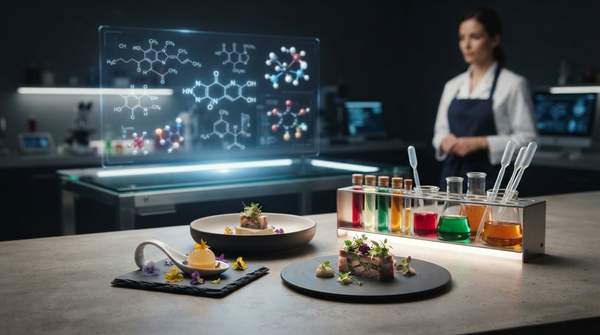
Artistic depiction of chocolate and blue cheese, and white chocolate with caviar, illustrating surprising food pairings based on shared flavor compounds.

Chocolate and blue cheese, a seemingly bizarre duo, share at least 73 flavor compounds, revealing the hidden science behind surprising food pairings. This extensive overlap of chemical components reveals that what appears to be culinary genius often stems from deep, underlying chemical commonalities, not just intuition. Even the unexpected pairing of white chocolate and caviar shares specific flavor compounds, including the odorant trimethylamine, which challenges conventional notions of taste harmony.

Many believe food pairing is purely an intuitive art, but scientific analysis reveals it is often driven by shared chemical compounds. This tension exists between the romanticized view of culinary creation and the growing body of evidence supporting a chemical foundation for flavor.

Understanding the chemical basis of flavor offers a systematic approach to creating novel and delicious food combinations, moving beyond traditional culinary wisdom. This perspective transforms culinary innovation from a purely artistic endeavor into an engineering challenge ripe for data-driven discovery.

The Science of Shared Scents and Tastes

Flavor, a symphony of sensations, marries taste and aroma. While our tongues discern the five basic tastes—sweet, sour, salty, bitter, and umami—it is the volatile aroma compounds, swirling unseen, that truly sculpt a nuanced profile. This intricate dance forms the bedrock of the 'food pairing hypothesis'.

Western cuisines, for instance, consistently favor ingredient pairs rich in shared flavor compounds, a pattern confirmed by PubMed. This consistent finding proves that even traditional recipes implicitly leverage chemical principles, dismantling the romantic notion of purely artistic creation. Identifying these shared compounds forges a scientific path to harmonious combinations, far beyond trial and error.

Potent odorants, like methyl hexanoate, weave through disparate foods—oysters, kiwi, white wine, blue cheese—a fundamental chemical thread driving unexpected, yet harmonious, pairings. Such shared chemical signatures prove that seemingly incompatible foods often possess a hidden unity.

How Scientists Uncover Perfect Pairings

Scientists now wield sophisticated tools to chart the intricate chemical landscape of food, systematically pinpointing potential pairings. A network-based approach, for example, meticulously links each ingredient to an average of 51 distinct flavor compounds, as detailed in Nature. This comprehensive mapping allows researchers to visualize and predict the subtle chemical dialogues between ingredients.

Machine learning, fused with extensive chemical analyses and sensory data, now crafts models that predict taste, smell, mouthfeel, and even appreciation from mere compound concentrations, a breakthrough detailed in Nature. This marks a profound shift: flavor creation is rapidly transitioning from an artisanal craft to an engineering discipline, where algorithms could design future culinary masterpieces. These sophisticated models have already characterized over 200 chemical properties across 250 commercial beers of 22 styles, linking them to sensory data from trained panels and over 180,000 public consumer reviews. This algorithmic approach, capable of predicting taste and smell from chemical concentrations, threatens to eclipse the era of the intuitive chef, potentially democratizing gourmet experiences but also risking a loss of traditional culinary craft.

Applying Flavor Science in Your Kitchen

Home cooks can harness flavor science to elevate their culinary creations. While a network-based approach reveals an average of 51 flavor compounds per ingredient, the true magic of a surprising pairing often hinges on a single, potent shared compound. Consider strawberry and coriander, united by the key odorant (Z)-3-hexenal, as reported by Culture Cheese Magazine. This proves that focusing on specific, powerful shared odorants can unlock novel harmonies.

Armed with the knowledge that oysters, kiwi fruit, white wine, and blue cheese all share methyl hexanoate, cooks can confidently explore these unexpected combinations. This scientific insight transcends mere intuition, offering a structured method for culinary experimentation. It reveals that the most daring pairings often rest on a foundation of shared molecular whispers, inviting a deliberate exploration of flavor beyond conventional boundaries.

Adopting this science-based approach empowers adventurous eaters and innovative chefs to deliberately seek out these chemical commonalities. This method sculpts novel, high-quality flavor combinations that delight the palate through predictable chemical outcomes, far beyond accidental discovery.

What are the basic principles of food pairing?

Food pairing's core principle centers on shared flavor compounds: ingredients with chemical commonalities are more likely to forge harmonious combinations. This 'food pairing hypothesis' asserts that unexpected pairings thrive on underlying chemical similarities, transcending subjective taste. It propels us beyond traditional categories, revealing a broader spectrum of compatible flavors.

How can aroma enhance food pairing?

Aroma profoundly enhances food pairing, contributing a vast, invisible symphony of volatile compounds perceived through our olfactory system. Scientific studies, like the one detailing over 200 chemical properties in beer, illuminate the intricate complexity of aroma profiles. Identifying shared odorants—even a single potent whisper like (Z)-3-hexenal in strawberry and coriander—can conjure surprising, delightful harmonies, proving aroma's critical, often subconscious, power in culinary success.

What is the role of texture in food pairing?

Texture sculpts the very experience of food pairing, defining a dish's mouthfeel and sensory appreciation. While taste and aroma deliver chemical signals, texture adds a vital physical dimension, shaping how flavors unfold and how satisfying a combination truly feels. Machine learning models, now predicting appreciation from compound concentrations, consistently integrate mouthfeel alongside taste and smell, underscoring its indispensable role in the complete culinary tapestry.

By 2026, many chefs may leverage advanced computational tools to identify novel flavor combinations, transforming the culinary world with data-driven discoveries that enhance the dining experience for adventurous eaters and home cooks alike.