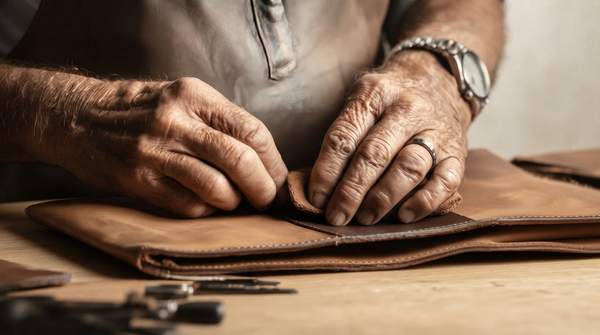
Bespoke leather goods are built through a multi-stage process in which the artisan's very first major decision—the type of tanned leather chosen—determines which construction and finishing techniques are even possible. A vegetable-tanned hide, stiff and absorbent, can have its edges burnished into a smooth, sealed finish that develops a rich patina over time. Softer, less absorbent finished leathers, often called chrome-tanned, cannot be burnished this way and must instead be skived and folded or painted with an edge coat. Understanding that link between material and method is the key to appreciating the skill, time, and value inherent in a handmade piece.
Stage 1: Design and Material Selection
Every bespoke piece begins with two intertwined decisions: what the item will look like, and what it will be made from. Selecting the right leather is treated by artisans as the foundation of the entire craft. Practitioners describe choosing hides meticulously based on grain pattern, texture, and durability, with premium full-grain and vegetable-tanned materials prized for the longevity and the rich patina they develop over time.
Within that selection, distinct leather families serve different purposes. Full-grain leather is regarded as the highest quality, known for its durability and natural imperfections. Top-grain leather is slightly processed for a smoother finish while maintaining strength. Vegetable-tanned leather stands apart as a natural option that ages beautifully, and it is the material most associated with traditional handcrafting.
The practical reason vegetable-tanned leather anchors traditional work becomes clear in how it is taught. An artisanal leatherworking curriculum from Domestika lists vegetable-tanned leather or cowhide as essential materials, alongside simple tools such as cutting blades, hole punches, and needles, for students progressing from foundational skills to professional-level creations. The material is not merely an aesthetic preference; it is the standard substrate for the core techniques of the craft.
Why does this choice matter so much? Because the leather's physical properties dictate the technique. Vegetable-tanned leather is stiff and absorbent, and that combination is exactly what allows its fibers to be compressed and smoothed during finishing. Softer, more pliable finished leathers—commonly grouped under the label "chrome-tanned" because chromium is used in their finishing process—lack that absorbency. As the leatherworking guide on Instructables explains, these finished leathers cannot be burnished in the way vegetable-tan can, which forces the artisan down a different construction path from the moment the hide is cut.
This is why material selection is a technical decision, not just a visual one. An artisan who plans burnished, polished edges must start with a leather whose fiber structure can support them. One working with soft chrome-tanned leather must plan for folded or painted edges before the pattern is even traced. The stages that follow—cutting the pieces, stitching and assembly, edge finishing, and final conditioning—all inherit the constraints set by this first choice.
Leather Type and Crafting Technique Matrix
The table below links each leather family's key physical property to the edge-finishing method it permits and the character that method produces. Use it in two directions: to understand why an artisan chose a particular leather for a desired outcome, and to read a finished product backwards—its edge treatment reveals the material and, by extension, the construction tradition behind it.
| Leather Type | Key Property | Edge Finishing Method | Resulting Characteristic |
|---|---|---|---|
| Vegetable-tanned leather | Stiff and absorbent; fibers can be compressed and smoothed | Burnishing: wetting, sanding, and rubbing the edge | Durable, polished, natural-looking edge that can develop a rich patina |
| Other finished leathers (e.g., chrome-tanned) | Softer, more pliable, and less absorbent; cannot be burnished like veg-tan | Skiving and folding the edge over, or painting with edge coat | Neat appearance, but without the same natural durability or patina development as burnished veg-tan |
The contrast is not a matter of skill but of physics. Burnishing works on vegetable-tan because the leather's absorbency lets moisture and friction compress the fibers into a sealed, smooth edge. On a chrome-tanned leather, the same technique simply fails, which is why the Instructables guide's author recounts hunting for alternatives after discovering finished leathers "cannot be burnished in the same way that veg-tan can."
Stage 4: Edge Finishing and Refinement
Edge finishing is where the material decision becomes visible, and where the labor of bespoke work is most concentrated. For vegetable-tanned leather, the artisan burnishes: the edge is wetted, sanded, and rubbed until the fibers compress into a smooth, sealed finish. The durability and polished appearance of that edge are a direct result of the burnishing process itself, and the same absorbency that makes burnishing possible also allows the leather to age into a patina.
For other finished leathers, the artisan must take a different route. The common approach, as described in the Instructables guide, is to thin the edge by skiving and fold the leather over on itself so no raw edge remains. Even then, excess glue must be cut or sanded away. The guide's author notes the difficulty of skiving evenly—a candid reminder that these alternative methods demand their own considerable skill and time. Where folding is impractical, an edge coat can be painted on to seal the edge.
Both routes can produce a clean result, but they differ in character. Folded or painted edges give a neat appearance, yet they do not offer the same natural durability or patina development as a burnished vegetable-tanned edge. Neither outcome is inherently inferior; each reflects a deliberate pairing of material and method, and each carries its own trade-off between natural aging and constructed neatness.
It is worth noting the scope of this picture: it describes traditional hand-crafting, not mass production, and focuses on how leather types relate to technique rather than cataloguing every leather available. Some stiff finished leathers, such as buffalo, exist outside this comparison, and the comparison here centers on the common vegetable-tanned versus chrome-tanned divide.
Appreciating Artisanal Craftsmanship Through Material and Method
When evaluating bespoke leather goods, prioritize understanding the leather type and its corresponding crafting techniques, especially the edge finishing, as these reveal the artisan's skill and the item's inherent quality. The edge is the most honest part of a leather piece: it cannot hide the material it was made from.
A simple inspection makes the craft legible. Observe the edge finish of a leather item: a smooth, dense, and naturally polished edge suggests burnished vegetable-tanned leather, indicating traditional handcrafting and potential for patina; a folded or painted edge suggests other finished leathers and different construction methods. That single detail connects the finished object back to the artisan's first and most consequential decision—and to the hours of technique that decision set in motion.
Sources
- Specialization in Artisanal Leather Crafting Techniques - Online Course — Domestika
- Introduction to Leatherworking — Instructables