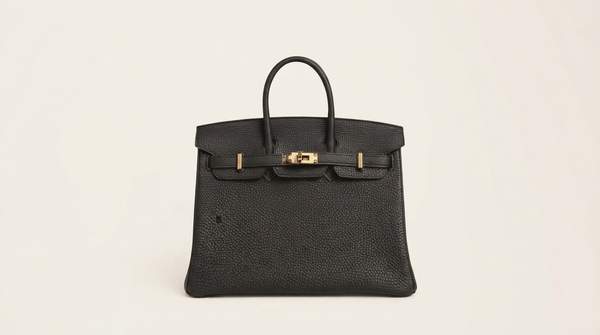
Few objects distill the logic of modern luxury as completely as the Hermès Birkin bag. Conceived in 1984 after a chance airplane encounter between the singer-actress Jane Birkin and Hermès chief executive Jean-Louis Dumas, it evolved from a practical solution for an overstuffed mother into the most coveted handbag in the world—one that shattered records in July 2025 when the very first example sold at Sotheby's in Paris for €8.6 million (£7.4 million; $10.1 million), making it, as the BBC reported, "the most valuable handbag ever sold at auction." The Birkin's story is one of design discipline, deliberate scarcity, celebrity mythology, and a secondary market that now treats handbags like fine art.
The Serendipitous Origin of an Icon
The Birkin bag began with an accident of seating. As the story is widely retold across collector guides and confirmed in outline by Hermès's own corporate history, Jane Birkin found herself seated next to Dumas on a flight in 1984 after spilling the contents of her bag. The encounter sparked a conversation about what a practical, elegant everyday bag for a busy woman might look like, and Dumas sketched a design—a collaboration that, according to Sotheby's, "would forever change the luxury handbag landscape."
The tale has become foundational to the bag's mythology precisely because it inverts luxury convention: the world's most exclusive accessory was born not from a marketing brief but from a spilled purse and a complaint. The BBC, covering the 2025 sale, notes that the black leather bag was made for Birkin in 1985 following that in-flight meeting, and that it "set the template for arguably the most coveted accessory in fashion history." That the first example still carried her personal touches—details Sotheby's describes as subtle leather, hardware, and stitching choices distinguishing it from every other Birkin—only deepened its aura when it came to market four decades later.
Signature Design and Enduring Craftsmanship
The Birkin's design has remained remarkably stable since its introduction, and that restraint is central to its appeal. Sotheby's identifies the signature elements as two rolled handles, a flap closure, sangles (the two side straps), a turn-lock, and clou feet, noting that the silhouette "has changed little since its introduction." Writing on the bag's design evolution, Rome Station adds that the lock, the clochette—the small bell-shaped leather cover housing the key—and the top handles were established from the start, with early models drawing on the proportions of Hermès's older Haut à Courroies bag for a slightly tall, boxy silhouette.
Equally important is how the bag is made. According to Privé Porter, each Birkin is handmade in France by a single artisan, stitched with waxed linen thread using the traditional saddle-stitch technique, in leathers such as Togo, Epsom, and Box, as well as exotic skins including Niloticus crocodile, Porosus, and ostrich. Production, the same account reports, can take up to 48 hours per bag. The bag is fully lined with goatskin in a color matching the exterior leather, and its hardware—described by collector guide Collector's Cage as solid brass polished by hand and plated in finishes such as gold, palladium, or ruthenium—varies its character without altering its form.
This construction underwrites a pricing logic Hermès itself defends on the grounds of the skill involved, with final prices depending on material, color, and hardware. A 2014 estimate cited on Wikipedia put production at roughly 70,000 Birkins that year—a volume that, against global demand, sustains the scarcity on which the bag's mystique depends. Privé Porter goes so far as to argue that Hermès "never markets the Birkin" because, in its telling, "the bag sells itself."
From Accessory to Cultural Phenomenon
What elevated the Birkin above other beautifully made handbags was its migration from boutique to culture. Collector's Cage attributes the bag's transformation into a cultural phenomenon to celebrity endorsements and social media, while also noting that its high value and exclusivity have sparked discussions about economic disparity within luxury consumerism—a tension that has become part of the object's meaning rather than a threat to it.
Artists, in turn, have made the bag a literal canvas and a symbol. Wikipedia's account of the bag in contemporary art records the painter Alec Monopoly creating hand-painted Birkins with graffiti motifs, and Sanuj Birla's Birkin Drip sculpture, which depicts a melting Birkin as a commentary on consumer culture. The artist Nagel, the same account notes, painted a Himalaya Birkin as a "projection surface onto which social meanings such as power, religion, and ideology can be mapped." When an object can carry that much interpretive weight, it has ceased to be merely an accessory; it has become a sign. Vogue's report from inside the 2025 Paris sale captured this directly, quoting the auctioneer opening with the words: "Much more than a simple bag, the Birkin has evolved from a simple accessory to a timeless cultural icon."
The Birkin Bag: A Chronological Journey of an Icon
Tracing the Birkin's milestones in sequence reveals how a functional design became an investment-grade asset, with each decade layering new value onto the last. The chronology below assembles the key documented events from the bag's four-decade arc, from its in-flight conception to its record-smashing return to the auction block.
| Year | Event or Milestone | Significance |
|---|---|---|
| 1984 | Chance meeting between Jane Birkin and Hermès executive Jean-Louis Dumas on a flight inspires the design, after Birkin spills her belongings. | The origin story, widely reported across multiple secondary sources and outlined in Hermès's own history, becomes central to the bag's mythology. |
| 1985 | The black leather bag made for Birkin following that encounter is completed, according to the BBC's account of the 2025 sale. | The first Birkin sets "the template for arguably the most coveted accessory in fashion history," per the BBC. |
| 2014 | An estimate cited in the bag's Wikipedia entry puts Hermès production at about 70,000 Birkins that year. | Limited volume relative to global demand underpins the scarcity that sustains the bag's status. |
| June 2017 | A Hermès Himalaya Birkin, named for coloring resembling the mountain range, sells at Christie's Hong Kong for $379,261, as reported by the auction-focused platform Invaluable. | Became, at the time, the most expensive handbag sold at auction—marking the bag's arrival as a top-tier collectible. |
| 2021 onward | Sotheby's reports it has sold over $100 million in Birkin bags since 2021. | Demonstrates sustained global demand in the secondary market, per the auction house's own sales data. |
| 2025 | A report by secondhand retailer ReBag, cited in the bag's Wikipedia entry, suggests 92% appreciation of Birkin value over the preceding decade. | Positions the Birkin alongside traditional appreciating assets in the resale market. |
| July 2025 | Jane Birkin's original Birkin sells at Sotheby's Paris for €8.6 million (£7.4 million; $10.1 million), as reported by the BBC, Vogue, and Sotheby's. | The most valuable handbag ever sold at auction; Sotheby's says it set new benchmarks for secondary-market pricing. |
Read together, the sequence shows escalation rather than stasis: each landmark—the 2017 Himalaya record, the post-2021 auction boom, the 2025 provenance-driven sale—raised the ceiling for the one that followed. The leap from $379,261 in 2017 to $10.1 million in 2025 illustrates how much of a Birkin's value now resides in narrative and rarity rather than leather and hardware alone.
Understanding the Birkin's Enduring Legacy
The Birkin's history supports a clear conclusion: recognize the Hermès Birkin bag as a unique blend of design, craftsmanship, and cultural cachet that has consistently driven its status as both a luxury icon and a significant investment. Its value proposition rests on verifiable foundations—an unchanged core silhouette, single-artisan construction, constrained supply—and on intangibles that are no less real for being unmeasured: celebrity association, artistic reinterpretation, and an origin story that functions as fashion folklore.
That legacy is also why the bag's financial reputation deserves careful framing. Invaluable cites cultural and economic sources, including Time magazine, concluding that Birkins have been a better investment than gold and less risky than stocks, with value increasing by an average of 14.2 percent per year; Collector's Cage similarly notes the bag's reach "into the sphere of investment." These are observations of past secondary-market performance, not guarantees, and this article offers no financial advice on luxury goods. The measurable indicator to watch is straightforward: continued high demand and record-setting prices in the secondary market—benchmarks Sotheby's says its July 2025 sale explicitly reset—will signal whether the Birkin's trajectory as both cultural icon and appreciating asset continues into its fifth decade.
Sources
- Jane Birkin's original Hermès bag sells for £7m at Sotheby's auction — BBC
- Everything You Need to Know About the Hermès Birkin — Sothebys.com
- How Jane Birkin's Original Hermès Birkin Bag Made History... Again — Sothebys.com
- The Evolution of Hermès Birkin Bag Design: Key Variations Over the Years — Rome Station
- The Icon That Built a Cult: The History of the Hermès Birkin Bag — Privé Porter
- Collector's Guide: Hermes Birkin Bag Designs and History — Collector's Cage
- Birkin bag - Wikipedia — EN
- Vogue Goes Inside the Auction of Jane Birkin’s Original Hermès Birkin Bag
- Why Are Birkin Bags So Expensive? History of Hermès Birkin Bags — Invaluable
- World Record Hermès Birkin Sale — Jane Birkin’s Original Birkin (2025) — Sothebys.com