A guest room may be one of the first photographs a traveler looks at when researching a hotel, but it is rarely the whole reason they choose a resort.
Luxury hospitality is built around the complete experience: arrival, architecture, surroundings, dining, amenities, service, atmosphere, recreation and the destination itself. When a resort's photography focuses too narrowly on bedrooms, it leaves much of that experience unseen.
Victor Elias Photography specializes in hotel and resort photography while also working across architecture, interiors, aerial, lifestyle and travel photography. With decades of international experience, the studio has photographed properties across destinations including Mexico, the Caribbean, Europe, the United States, Canada and Central America.
For luxury resorts looking to refresh their image library or prepare for a new marketing campaign, that broader perspective can help answer a crucial question: What should prospective guests see before they decide to book?
Start with the setting
For many resorts, the destination is part of the product.
A beachfront property is selling access to a coastline. A mountain resort is selling its relationship with the landscape. A tropical property may be defined partly by vegetation, climate and outdoor living.
The setting deserves to be photographed with the same care as the guest rooms.
Wide exterior images can establish where the property is. More focused architectural images can show how the resort interacts with its surroundings. Aerial photographs can connect the two by providing a larger view of the property and its environment.
Victor Elias Photography includes aerial and travel photography among its specialties, complementing its core hotel and resort work.
This is especially valuable for international properties whose destination is a major part of their appeal.
Photograph the architecture as a destination experience
Architecture can make a resort recognizable.
Distinctive buildings, arrival spaces, terraces, courtyards, pools and landscape design all contribute to the first impression.
Yet architecture photography should do more than show what a structure looks like.
It can communicate how the property is meant to be experienced.
An entrance can create anticipation. A courtyard can reveal a sense of privacy. A terrace can connect the interior with the landscape. A pool can become a visual transition between architecture and nature.
These details help distinguish a resort from another property offering similar room categories.
Victor Elias Photography's specialization in architectural photography gives hospitality clients an opportunity to make those design elements part of the property's broader visual identity.
Give interiors their proper role
Luxury resorts often invest heavily in interiors.
Furniture, materials, artwork, lighting and spatial design are selected to create a particular atmosphere. Those choices influence how guests perceive quality and comfort.
Photography needs to communicate that atmosphere.
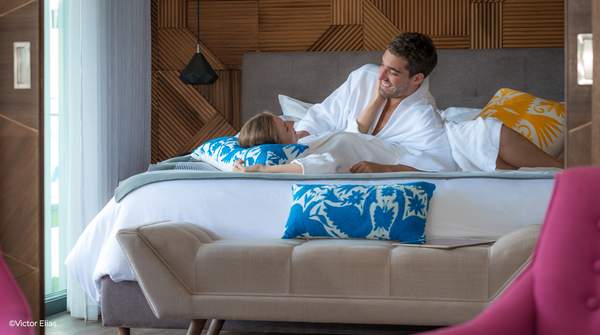
A guest room photograph can show more than the bed. It can reveal the relationship between sleeping and living areas, the view outside, the materials used throughout the space and the details that make the room distinctive.
Public spaces deserve the same attention.
Restaurants, lounges, bars, spas and gathering spaces can help communicate the personality of the resort.
Published work by Victor Elias Photography includes imagery for major hospitality properties where architectural and interior design are central to the guest experience.
That type of coverage can help a resort present a much more complete picture of its environment.
Show the amenities guests are actually choosing
Amenities can be among the strongest visual differentiators for resorts.
A pool, spa, restaurant, beach club, fitness center or recreational facility may be a major reason a traveler chooses one property over another.
Those spaces deserve intentional photography.
The objective is not to photograph every amenity simply for the sake of having a picture. The better question is what each space contributes to the guest experience.
A spa photograph can communicate calm and privacy. A restaurant photograph can establish atmosphere. A pool photograph can communicate relaxation or energy depending on the property.
This approach turns amenities into parts of the resort's story rather than isolated inventory.
Current messaging from Victor Elias Photography specifically emphasizes imagery of rooms, amenities, restaurants and guest experiences as part of its hospitality visual strategy.
Let lifestyle photography create identification
Travelers often make decisions based on imagination.
They look at a resort and ask themselves whether they can see themselves there.
Lifestyle photography can help answer that question.
Instead of showing only an empty lounge, a photograph might communicate how the space feels during an actual guest experience. Instead of photographing a dining room as an architectural interior, lifestyle imagery can show the atmosphere of an evening meal.
That human element adds context.
It also gives marketing teams more flexible content for campaigns aimed at different audiences. Couples, families, wellness travelers and experience-focused guests may each respond to different aspects of the same property.
The photography should therefore represent the range of experiences the resort genuinely offers.
Use aerial imagery strategically
Aerial photography can be one of the most powerful tools in a resort's visual library because it changes the viewer's perspective.
From the ground, a guest sees a pool. From above, they can see how the pool relates to the buildings, gardens, beach and surrounding environment.
From the ground, a resort may feel like a series of individual spaces. From above, its overall scale becomes easier to understand.
This can be especially useful for large properties.
Victor Elias Photography identifies aerial photography as one of its established specialties and has produced aerial imagery for hospitality properties, including work represented in hotel media libraries.
For destination resorts, those images can help communicate a sense of place that standard interior photographs cannot provide.
Think beyond the booking page
A resort's photography rarely stays in one place.
Images can appear on the property's website, booking channels, social media, digital advertising, brochures, sales presentations, travel publications and partner websites.
That means the photography needs to offer variety.
A single room photograph may be useful on a booking page. An aerial photograph may work as a campaign opener. A lifestyle photograph can support social content. A detailed architectural image may be useful for a design publication.
The more comprehensive the library, the more opportunities the marketing team has to tell different aspects of the same story.
Victor Elias Photography reports that its hospitality images have been used to promote properties in print and online, with work appearing across travel websites and publications internationally.
Plan around the resort's rhythm
Resorts have their own rhythms.
Some spaces are busiest during the day. Others are most atmospheric in the evening. Outdoor areas may depend heavily on sunlight and weather. Restaurants may need to be photographed before service begins. Guest rooms require preparation.
A professional shoot needs to account for these realities.
Planning can help determine which spaces should be photographed at sunrise, which benefit from afternoon light and which should be captured after dark.
Victor Elias Photography describes pre-shoot planning as part of its current approach, with attention to angles, lighting, architectural details, post-production and brand consistency.
That planning is particularly valuable when the photographer is traveling internationally and the production window is limited.
Choose a photographer who can come to the resort
A luxury resort does not need to be near a photographer's studio to receive specialized hospitality photography.
The assignment can travel.
This matters for destination properties because their location is often one of their greatest assets. A photographer who works internationally can go directly to the property and build the visual production around the actual destination.
Victor Elias Photography has traveled extensively for hospitality work and has photographed hotels and resorts across multiple regions. Legal records also document Victor Elias's specialization in hotels and resorts across the United States, Mexico and the Caribbean.
For resort owners and marketing teams, that flexibility opens the door to specialized photography even when the property is far from a photographer's home base.
Capture the experience, not just the inventory
The most important shift for luxury resort photography is to stop thinking only in terms of rooms and start thinking in terms of experiences.
Guests do not book a resort because they want a photograph of a bed.
They book because they want the morning view, the pool, the meal, the spa treatment, the beach, the architecture, the privacy, the atmosphere or the feeling of being somewhere special.
Photography cannot reproduce an entire vacation, but it can give prospective guests a meaningful preview of what that vacation could feel like.
That is why a comprehensive resort photography assignment should move from lobby to landscape, from architecture to interiors, from amenities to lifestyle.
Give your resort a complete visual story
Every luxury resort has something it wants future guests to understand before they arrive.
Perhaps it is the architecture. Perhaps it is the destination. Perhaps it is the design, the culinary experience, the wellness offering or the connection to nature.
Whatever the defining characteristic, photography should make it visible.
Victor Elias Photography brings hotel and resort photography together with architectural, interior, aerial and lifestyle expertise, while maintaining the ability to travel internationally for assignments.
For resorts preparing to open, renovate, reposition or refresh their marketing, that combination can provide a practical foundation for building a more complete image library.
The guest room still matters. It simply should not be the end of the story.
When prospective guests can see the property from lobby to landscape, understand its architecture, explore its interiors, imagine its experiences and appreciate its setting, the photography begins doing something more valuable than documenting the resort.
It starts introducing them to the experience they came to find.