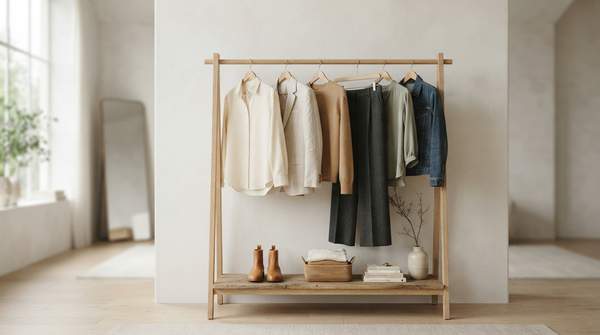
A sustainable capsule wardrobe is a curated collection of versatile, high-quality pieces that work together across seasons, reducing the need for constant new purchases while minimizing environmental impact. That definition, offered by Judith Soto at LaliSimone, captures the core trade-off the method asks you to make: fewer garments, chosen with more care. The payoff is twofold — less waste and less spending over time, without giving up personal style. This guide explains the principles behind the approach, how to evaluate eco-conscious materials, how to maintain what you own, and how to apply a repeatable decision framework to every garment you consider keeping or buying.
Introduction: The Sustainable Capsule Wardrobe Explained
A capsule wardrobe is a small selection of clothes — think t-shirts, blouses, skirts and trousers — that combine into a variety of outfits. Writing at Milimilu.com, Linda Morrison describes its key characteristics: pieces that do not go out of fashion, that are versatile, timeless and of high quality, often in classic styles and neutral colors. The capsule concept is already sustainable in itself, in her framing, because it promotes owning fewer clothes and more high-quality items that last longer.
The "sustainable" modifier adds a second layer: the garments themselves should be produced and distributed in as environmentally conscious a way as possible. A guide from Lindenwood University identifies the core principles of sustainable fashion as supply chain transparency, ethical labor practices, collaborative consumption, circularity and recycling, and production methods with minimal environmental impact. Combine the two ideas and you get a wardrobe that is deliberately small and deliberately responsible.
Core Principles of Sustainable Wardrobe Building
Research on consumer motivations, published in the Journal of Sustainability Research, frames the capsule wardrobe as an expression of socially responsible consumer behavior — basing the acquisition, use and disposal of products on the desire to minimize harmful effects and maximize positive long-term impact on society. Fashion consumers who value sustainability look for alternatives that minimize damage to the planet, the research notes, without compromising the style they wear.
Five principles emerge from the evidence. First, reduce consumption: the goal of a capsule wardrobe is to buy fewer, better things, as Sarah Baker puts it in PÜR Evergreen's guide — a high-quality item may cost more upfront but lasts much longer, saving money and resources in the long run. Second, choose durable, timeless pieces with strong construction, classic silhouettes and colors that mix and match. Third, prioritize eco-conscious materials. Fourth, embrace ethical production: transparency and responsible manufacturing are part of what makes clothing sustainable. Fifth, extend the lifespan of what you own through care and repair, which reduces the need for new purchases.
As Soto summarizes the philosophy: "The core principle is simple: own fewer items that you genuinely wear and love." She stresses that the approach is about clarity rather than deprivation — when pieces genuinely coordinate and reflect your actual style, getting dressed becomes easier and the environmental benefit follows naturally from the practical one.
Your Sustainable Capsule Wardrobe Decision Framework
The framework below turns those principles into a sequential test you can apply to any garment — one already hanging in your closet or one you are considering buying. Work through the questions in order; a garment must pass each stage to earn a place. The output is a clear keep-or-acquire decision versus a discard-or-pass decision, which is what separates deliberate curation from ad-hoc accumulation.
| Step | Question to ask | What a "yes" looks like | If the answer is "no" |
|---|---|---|---|
| 1. Versatility | Does it combine with at least several other pieces I own, across seasons? | Classic silhouette, neutral or easily mixed colors; fits multiple outfits from a small selection | It will rarely be worn — pass or discard |
| 2. Durability and quality | Is it well constructed enough to last through repeated wear? | Strong construction; high-quality material designed to endure | It will need replacing soon — pass or discard |
| 3. Material sustainability | Is it made from eco-conscious materials or sourced secondhand? | Organic cotton, linen, hemp, recycled fibers, or a preloved/vintage piece | Consider a better alternative before buying |
| 4. Ethical production | Can I find evidence of responsible manufacturing? | Brand demonstrates transparency and ethical labor practices | Research further or choose another maker |
| 5. Personal style | Do I genuinely love it and will I actually wear it? | It reflects your real style, not an impulse or a trend | Even a "perfect" garment fails this test — pass or discard |
The order matters. Versatility and durability come first because they determine whether the garment can function inside a small, interchangeable collection at all. Material and production questions then determine whether acquiring it aligns with sustainable principles. Style comes last but is not optional: Soto's point about owning pieces you genuinely wear and love is what keeps a capsule wardrobe from becoming a rigid rule set. A garment that passes all five stages is a keep or acquire; anything that fails an early stage can be re-evaluated only if that failure can be remedied — for example, a repairable tear in an otherwise excellent piece.
Prioritizing Sustainable Materials
Material choice is a significant factor in a garment's environmental footprint. Baker's guide recommends fabrics such as organic cotton, linen, hemp and recycled materials — fibers that, in her description, do not need large amounts of water or chemicals to produce. She also highlights reduced pollution as a criterion: minimizing harmful dyes and chemicals and cutting carbon emissions during production.
Two practical qualifications apply here. This article does not attempt a detailed scientific comparison of fabric impacts, and the evidence reviewed does not supply specific figures such as exact water savings for organic versus conventional cotton — so treat material categories as directional guidance rather than measured outcomes. Second, sourcing secondhand is itself a material strategy: Soto's guide treats vintage and preloved contemporary pieces, selected for their craftsmanship and design, as a legitimate route to a sustainable capsule, since it extends the life of existing garments rather than creating demand for new production.
When evaluating a new purchase, the framework's material step can be as simple as checking the fiber content label and asking whether the brand communicates anything about its production. Where a brand offers no transparency, that absence is itself information for the ethical-production question.
Maintaining Your Sustainable Wardrobe for Longevity
Building the wardrobe is only the beginning; maintenance is what makes it sustainable over time. Baker's care advice is concrete: follow washing instructions carefully, wash less often, use cold water, and air dry whenever possible. Beyond washing, the evidence points to repair as the single most consequential habit.
Repairing clothes is a cost-effective alternative to buying new, Monica I. Johnson writes at Planet Aid — learning basic sewing skills and investing in repair kits can save considerable money in the long run while encouraging a mindset of frugality and environmental consciousness. A UK study of citizens' repair behavior, published at PMC, found that participants typically engaged in repair or repurposing about every six months, and identified the main barriers as lack of skills, poor product design, unaffordable repair services and a sense that repair conflicted with personal identity. Its enablers are instructive: emotional attachment to clothing, beliefs about the benefits of repairing, and having routines and habits of repair. In other words, the capsule method supports repair — you care more about pieces you chose deliberately.
Writing at The Conversation, Ingrid Haugsrud and Réka Tölg note that some retailers now offer genuine aftercare — repair services, accessible original parts, patches, and repurposing or tailoring — and recommend looking for brands that provide it. For end of life, Baker's guide suggests designing with disposal in mind: asking whether a garment can be recycled or composted when you are done with it.
Embracing a Mindful Fashion Future
Commit to a sustainable capsule wardrobe by consistently applying the decision framework and practicing mindful garment care. The evidence supports this as a coherent strategy: the Journal of Sustainability Research frames capsule adoption as socially responsible consumption that minimizes harm without sacrificing style; the curation guides show that fewer, better, versatile pieces reduce waste and spending; and the repair research shows that extending garment life is a learnable habit, enabled by emotional attachment and routine.
The measurable indicator of success is a noticeable reduction in new clothing purchases, increased use of existing wardrobe items, and active engagement in garment repair and responsible disposal. Those are observable behaviors you can track over a season: fewer acquisitions, more outfits from what you already own, and repairs actually completed rather than postponed. A wardrobe that passes that test is doing exactly what the capsule method promises — expressing your style while shrinking the footprint of getting dressed.
Sources
- How to Build a Sustainable Capsule Wardrobe — LaliSimone
- Sustainable capsule wardrobe: How to get started — Milimilu.com
- Sustainable Fashion: Eco-Friendly Practices in the Industry — Lindenwood University
- Sustainable and Responsible Consumption: An Investigation of Consumer Motivations for Adopting a Capsule Wardrobe — Journal of Sustainability Research
- How to Build a Capsule Wardrobe with Eco-Conscious Clothing — PÜR Evergreen
- Extending the Lifetime of Clothing through Repair and Repurpose — PMC
- Five ways to make your clothes last longer — The Conversation